
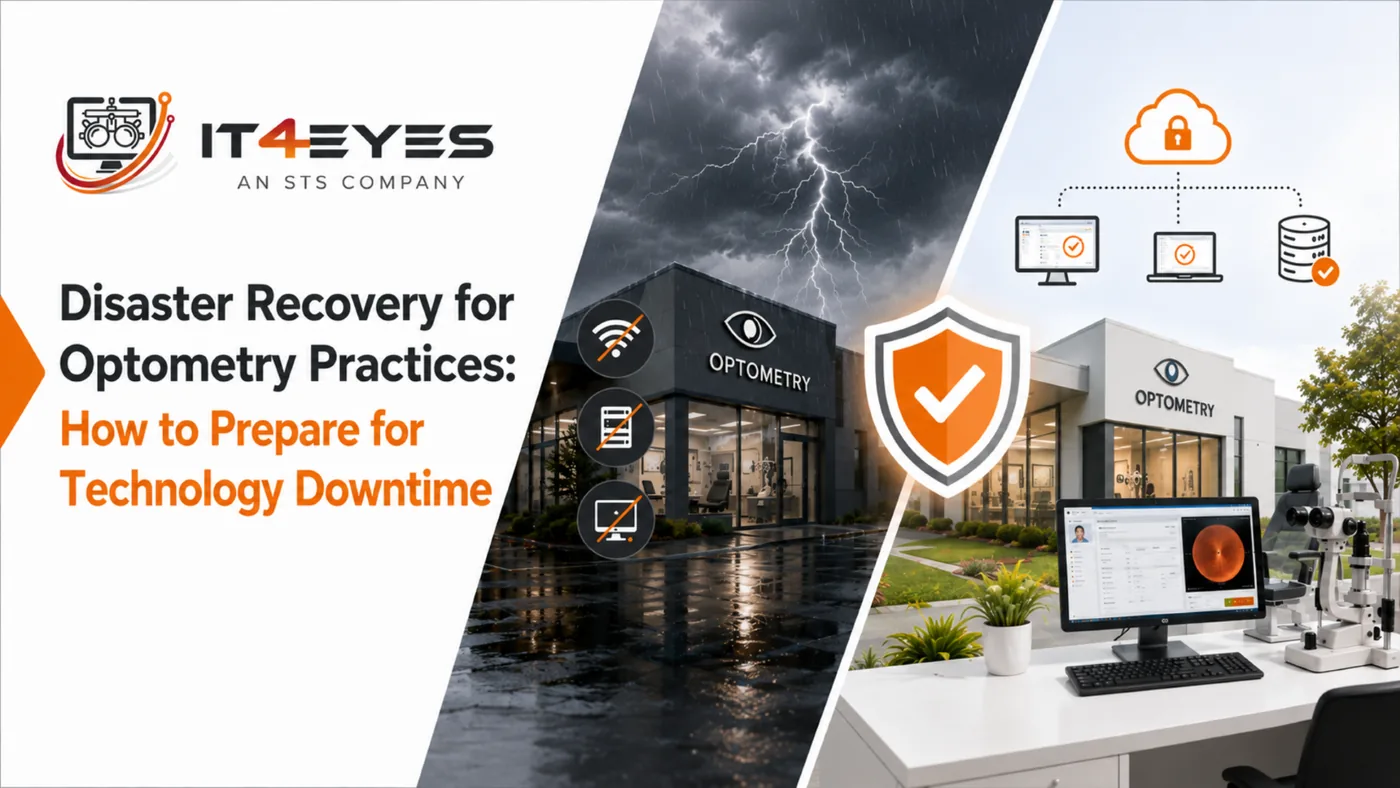
It's 8:00 a.m. on a busy Monday. Your front desk manager arrives to discover the EHR (Electronic Health Record) won't load. The practice management system is offline, patient schedules are inaccessible, and diagnostic images can't be retrieved. By the time vendors are contacted and the cause is identified, three hours have passed. If your practice averages $800–$1,200 in revenue per provider chair hour, that outage could easily represent several thousand dollars in lost production—not including frustrated patients and overtime for your staff.
The problem isn't just the technology failure. It's what happens when there isn't a plan for recovering from it.
1. The Hidden Risks Most Practices Overlook
When people hear "disaster recovery," they often think of hurricanes or fires. In reality, the events most likely to interrupt an optometry practice are much more common.
These include:
Server or hardware failures
Ransomware or other cybersecurity attacks
Internet outages
Power interruptions
Failed software updates
Human error, such as accidental deletion of important data
Each of these can stop patient care just as effectively as a major natural disaster. Even a two-hour outage can create scheduling backlogs that ripple through the rest of the week.
2. Why Recovery Is Harder Than It Should Be
Most practices purchase technology over time rather than all at once. The EHR comes from one vendor, imaging equipment from another, cloud backups from a third, and internet service from yet another provider.
When something fails, every vendor typically focuses on its own product.
One may say the network is working. Another points to the EHR vendor. The EHR vendor believes it's an internet issue. Meanwhile, your staff is left coordinating phone calls instead of seeing patients.
Without clearly defined responsibilities and documented recovery procedures, valuable time is lost simply determining who owns the problem.
3. A Better Approach: Business Continuity Planning
Disaster recovery focuses on restoring technology after an outage. Business continuity goes one step further by ensuring your practice can continue operating while recovery is underway.
An effective disaster recovery framework includes several key components:
Identifying which systems are most critical to patient care.
Maintaining secure, tested backups of patient records and business data.
Establishing clear recovery priorities so the most important systems come back online first.
Documenting responsibilities before an emergency occurs.
Testing the recovery plan regularly instead of assuming it will work.
A written plan removes guesswork during stressful situations. Everyone knows what to do, who to call, and which systems take priority.
4. The Financial Cost of Downtime
Many practice owners underestimate how quickly technology outages become expensive.
Consider a conservative example:
A two-provider practice experiences a four-hour outage caused by a failed server.
Potential impact may include:
$6,400–$9,600 in delayed or lost production (assuming $800–$1,200 per provider chair hour)
20–40 appointments requiring rescheduling
Four to six hours of staff overtime managing scheduling and documentation
Reduced patient satisfaction due to longer wait times and canceled appointments
Even if every patient is eventually seen, recovering from the disruption often requires additional administrative work that extends well beyond the day of the outage.
Compared with those costs, investing a few hours each year to review and test a disaster recovery plan is often one of the highest-value risk management activities a practice can undertake.
Key Questions to Ask Your Technology Providers
Before an emergency happens, ask your vendors:
How often are our backups performed?
How quickly can our systems realistically be restored?
Who coordinates recovery if multiple vendors are involved?
Have our backups been tested recently?
What can our staff continue doing if our primary systems become unavailable?
If those questions don't have clear answers, it's worth addressing the gaps before an emergency exposes them.
Making the Transition
Improving disaster preparedness doesn't have to happen all at once.
A practical approach looks like this:
Inventory your critical systems and vendors.
Verify that backups are running successfully and being tested.
Document recovery procedures and key contact information.
Train staff on what to do during different types of outages.
Review and test the plan at least annually or after major technology changes.
Small improvements made today can significantly reduce disruption later.
Frequently Asked Questions
Is disaster recovery only necessary for large practices? No. Smaller practices often have fewer technology resources and may feel the impact of downtime even more because there are fewer manual workarounds available.
If our data is backed up in the cloud, are we covered? Not necessarily. Backups are only one part of disaster recovery. Your practice also needs documented procedures for restoring systems and continuing operations during an outage.
How often should a disaster recovery plan be updated? At least once a year, and whenever major technology changes occur, such as implementing a new EHR, replacing servers, or adding diagnostic equipment.
Does cybersecurity belong in a disaster recovery plan? Yes. Cyberattacks, including ransomware, are among the most common reasons healthcare organizations activate disaster recovery procedures.
Will creating a disaster recovery plan disrupt daily operations? Typically, no. Most planning activities can be completed during scheduled IT reviews and require far less time than recovering from an unplanned outage.
Prepare Before the Emergency Happens
Technology failures aren't always preventable, but prolonged downtime often is. At IT4Eyes, we help optometry practices develop practical disaster recovery strategies, coordinate technology vendors, verify backup systems, and create recovery plans that minimize disruption when the unexpected occurs.
Schedule a technology assessment with IT4Eyes to evaluate your disaster recovery readiness and help keep your practice running—even when technology doesn't.