Documentation is an important part of patient care, but it can also take considerable time.
Eye care providers review patient histories, record examination findings, discuss treatment plans, and make sure their electronic health record (EHR) accurately reflects each visit. Even with an efficient workflow, notes can pile up between appointments or remain unfinished at the end of the day.
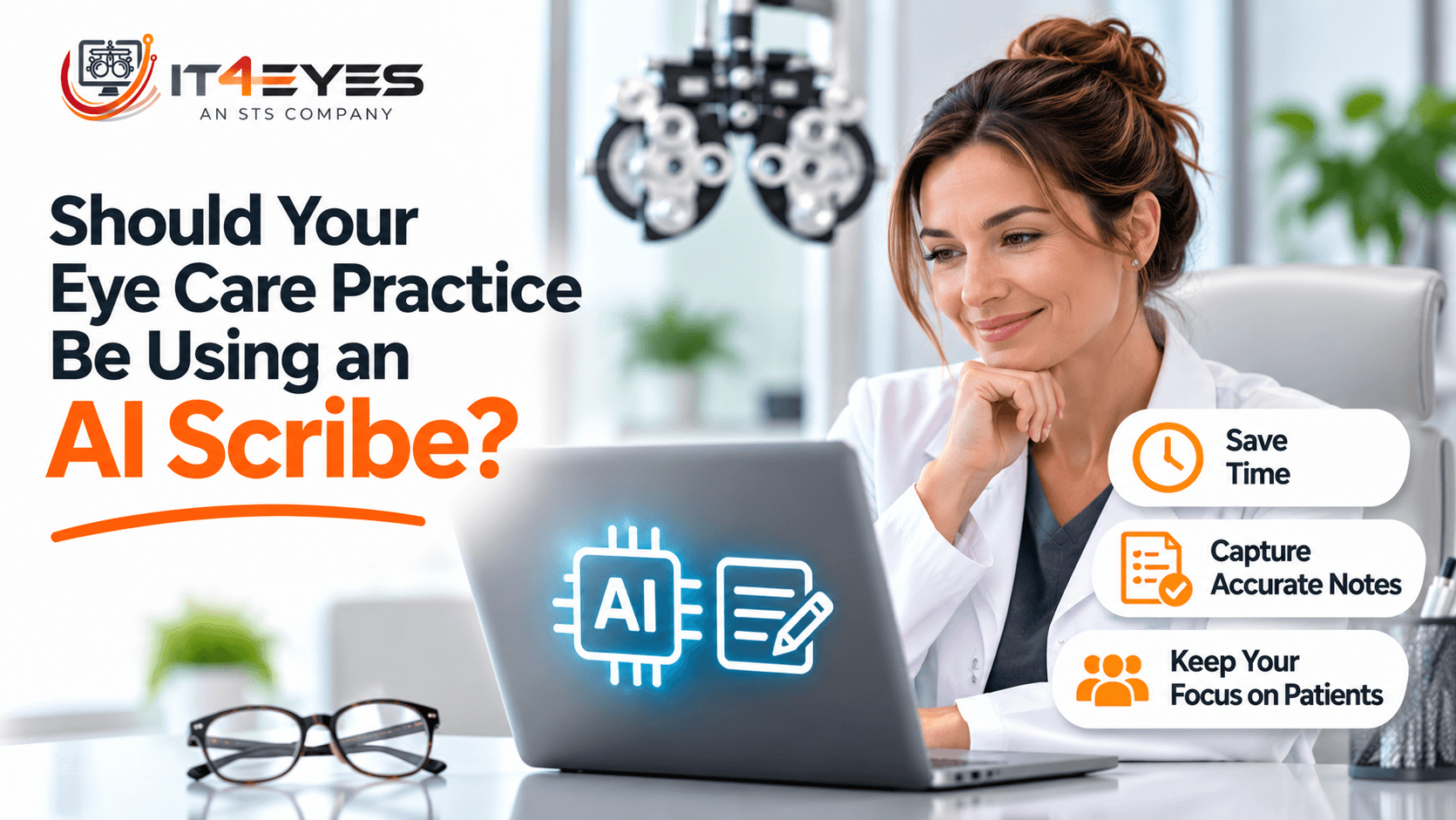
That's one reason AI scribes are attracting attention in healthcare. Some tools can listen to a patient encounter and generate a draft clinical note for the provider to review. The promise is appealing: less time typing and more attention for patients.
But before your practice introduces an AI scribe, it's worth looking beyond the product demonstration. Accuracy, privacy, compatibility, and everyday workflow all determine whether the tool will actually help.
What Does an AI Scribe Actually Do?
An AI scribe uses technology to help create clinical documentation. Depending on the product, it may capture a conversation, transcribe what was said, and organize information into a draft note.
Some products operate separately from your EHR, while others integrate with certain systems. Some mainly transcribe speech; others attempt to summarize or structure findings.
These differences matter. An AI scribe is not a substitute for the provider's clinical judgment. It produces documentation that a qualified clinician must review, correct, and approve.
Before considering any product, ask for a demonstration using workflows similar to those in your practice, not just a general medical example.
Why Are Providers Interested?
Consider a busy day of eye examinations. A doctor moves between patients, reviews diagnostic images, discusses symptoms, and documents what happened during each visit.
An effective AI scribe may reduce some manual note-taking and help providers finish documentation sooner. It may also make it easier to maintain eye contact and stay engaged during conversations instead of repeatedly turning toward a computer.
Those are potential benefits, not guarantees.
If a tool creates notes that require extensive editing, it may trade typing time for correction time. The right measurement isn't how impressive the generated note looks. It's whether the process becomes easier without sacrificing accuracy or care.
Eye Care Documentation Has Unique Requirements
Eye care visits involve specialized findings that may not be captured through conversation alone.
Visual acuity, intraocular pressure, refractive measurements, retinal findings, and diagnostic imaging results may come from examinations or equipment rather than spoken discussion. Providers must also document details such as which eye is affected.
Imagine an AI scribe accurately summarizes a patient's symptoms but cannot retrieve findings from an OCT or visual field test. The provider may still need to enter those results manually.
That doesn't automatically make the product a poor choice. It means the practice should understand exactly what the tool captures, what it cannot access, and where manual documentation remains necessary.
Ask whether it understands eye care terminology and whether it handles findings and laterality consistently. A tool designed around general office visits may require additional review in a specialized practice.
What Happens When the AI Gets Something Wrong?
AI-generated notes can sound confident and polished even when they contain mistakes.
A system might misunderstand a medical term, confuse who said something, omit an important detail, or insert information that was never established during the encounter.
For example, it could mistake a family history of glaucoma for a diagnosis in the patient. It might record a finding for the wrong eye or summarize a treatment recommendation incorrectly.
Those aren't just grammar problems. They can affect the meaning of the clinical record.
Every generated note needs a meaningful review before approval. The provider should verify diagnoses, examination findings, laterality, medications, treatment plans, and anything else important to the visit.
The goal is not simply a complete-looking note. It's an accurate one.
Where Does the Patient Information Go?
Before allowing an AI scribe into an examination room, understand how it handles information.
Does it record or temporarily process audio? Is the conversation transmitted to a cloud service? Are recordings or transcripts stored, and for how long? Who can access them? Does the vendor use patient information to train or improve AI models? What happens to the data when you stop using the service?
A product described as secure or healthcare-focused doesn't automatically answer those questions.
Clinical conversations may contain protected health information, so practices need to understand the flow of that information, including any subcontractors involved in processing it.
You should be able to explain where information goes and what safeguards protect it before the system is used with real patients.
What About HIPAA and Patient Trust?
For practices subject to HIPAA, a vendor that creates, receives, maintains, or transmits protected health information on the practice's behalf may be a business associate. An appropriate business associate agreement may therefore be required.
But an agreement alone isn't a complete security review. Ask about access controls, MFA, audit logs, incident response, retention, and deletion practices. The practice should evaluate how the tool fits its own privacy and security responsibilities.
Patients may also have questions. Are their conversations being recorded? Who reviews the notes? Can they decline use of the tool?
Be prepared to explain what the AI scribe does in plain language. Review applicable consent and recording laws, along with your privacy policies, and create a workable alternative when the tool shouldn't be used.
Technology should help providers communicate with patients, not make patients uncertain about who is listening.
Will It Work With Your EHR and Equipment?
A tool may generate a good draft but still create extra steps if it doesn't work with your existing systems.
For example, staff might need to copy text between applications, correct misplaced fields, or sign into a separate platform for every visit. That can reduce the time savings considerably.
Ask whether the vendor supports your particular EHR, what information transfers, and whether notes remain drafts until a clinician approves them. Clarify whether diagnostic measurements and imaging results must still be entered separately.
Also ask who supports the integration when something stops working: the AI vendor, the EHR vendor, or your IT team?
Clear responsibilities matter, especially when a technical issue occurs during a full patient schedule.
Test It Before Rolling It Out Everywhere
Instead of introducing an AI scribe across the entire practice immediately, consider a limited pilot after completing the necessary privacy, security, and vendor reviews.
Decide what success looks like. Is the goal to reduce documentation time, finish notes before the end of the day, or help providers stay more engaged during visits?
Track the time spent generating and correcting notes. Look for omitted findings or repeated errors. Ask providers and staff whether the tool improves their workflow, and listen to patient feedback when relevant.
A useful pilot tests actual eye care appointments and documentation requirements, not just whether the software can create a convincing paragraph.
If the results are mixed, identify why before expanding the rollout. Sometimes training or configuration helps; sometimes the product simply isn't a good fit.
Have a Plan for When It Isn't Available
An AI scribe may depend on internet access, cloud services, and connections to other applications. Those services can experience interruptions.
Providers should be able to document visits safely using their normal EHR workflow if the AI tool is unavailable. Staff should know how to report problems, locate unfinished drafts, and confirm that notes weren't lost or duplicated.
A convenience tool should not become something your practice cannot function without.
The Right Question Isn't Just Whether AI Can Write Notes
AI scribes have genuine potential to reduce documentation work and help providers focus on patients. But the value depends on how reliably the product supports your specific clinical workflow.
Accuracy, specialized eye care terminology, EHR compatibility, patient privacy, vendor security, and staff adoption all deserve attention before a purchase.
Don't judge the tool only by a polished demonstration. Judge it by how it performs with real tasks, how much review it requires, and whether it makes the work easier for the people providing care.
Ask one question before moving forward:
Will this AI scribe save our team time while keeping our clinical documentation accurate, our patient information protected, and our patients comfortable?
That answer is a much better guide than the promise of automation alone.