
Recall the days of blowing into Nintendo cartridges to get them working? That was our makeshift IT support back then.
Cartridge not loading? Blow gently. Still nothing? Blow harder.
If that failed, a firm tap on the console was your next move.
We believed we were tech-savvy.
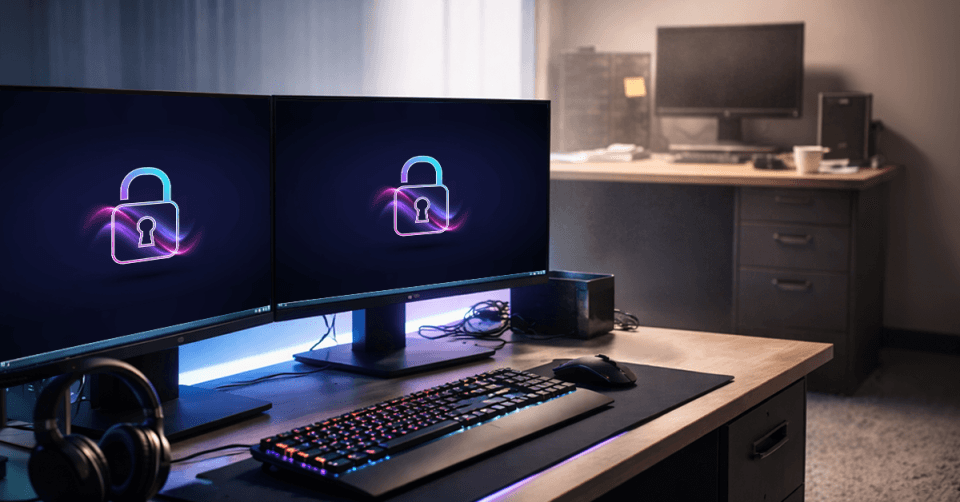
But your child? They've never had to fix tech by hitting it. Their setup includes a solid-state drive, 32 GB RAM, a processor capable of rendering mini-films, mesh Wi-Fi eliminating dead zones, real-time performance tracking, and multi-factor authentication on every login.
Every element is fine-tuned, maintained, and optimized.
Now, consider your office environment.
A workstation from 2019 that takes minutes booting up, a printer that jams like clockwork every Tuesday, chaotic shared folders named "New New Final FINAL," incompatible software systems, conference room Wi-Fi that mysteriously drops, and laptops that delay updates daily.
Gamers optimize relentlessly. Businesses often settle for inefficiency.
And this productivity gap can be unexpectedly costly.
Why Gamers Outperform Businesses
It's not about budgets. Quality gaming PCs cost about the same as business workstations. Business internet often surpasses home speeds, and effective network security tools are affordable.
The real difference? Dedicated attention.
Gamers eagerly apply updates: OS patches, graphics drivers, firmware, game patches—immediately and enthusiastically—because outdated software causes lag, and lag causes defeat. Your child even installs updates at 11:30 PM on a school night to avoid delay.
In contrast, every postponed update on office devices is a known vulnerability waiting to be exploited—patches released but uninstalled.
Gamers back up save files religiously—a lost 200-hour save is a tough lesson. Yet, around 68% of small businesses lack documented disaster recovery plans (Nationwide Insurance). Losing business data means losing client records, financials, and operational ability.
Gamers continuously monitor performance metrics—CPU temps, frame rates, ping times, disk usage—and troubleshoot minor dips before they escalate. Most businesses notice issues only when employees complain about slow internet, a reactive instead of proactive approach.
Your child wouldn't tolerate such inefficiency, yet their setup isn't paying anyone's salary.
How Office Tech Gets Messy
No one intentionally creates chaotic office technology.
Business tech grows organically. Tools are added to solve immediate problems—accounting software here, CRM there, then file sharing, payroll, security layers. Each addition made sense at the moment.
Over time, tech stacks up without strategy, turning from design into accumulation, inevitably causing friction.
Gaming rigs are purpose-built for performance; most business systems emerge from convenience. One is strategic, the other accidental—and accidental systems become costly liabilities.
Back in the cartridge days, we didn't know better. Your business can't use that excuse. The technology and expertise to optimize exist—what's missing is focused attention.
The Hidden Costs You Overlook
The true expense isn't a massive outage but daily inefficiencies everyone tolerates.
Minutes lost waiting for slow logins, searching misfiled documents, entering duplicate data across unsynced systems, rebooting systems, and rigging workarounds because "that's how it is here."
Seem trivial? Research from UC Irvine shows it takes 23 minutes to fully regain focus after interruptions. A five-minute tech hiccup costs nearly half an hour in lost focus.
Scale that across your team, weeks, months, and it totals thousands of lost productivity hours—invisible but damaging.
In gaming, lag is unacceptable; in business, lag is normalized. And "normal" is the costliest problem in tech.
The Critical Question to Ask
Business owners often say technology "works fine."
But "working" and "working smartly" are worlds apart.
Are your tools truly integrated or merely coexisting? Are your systems streamlined or just piled up? Do your processes leverage your technology, or are they improvised around it? Is someone monitoring your network proactively, as a gamer monitors frame rates?
Hardware cycles out, but software, automation, security, and workflows drive sustainable productivity and profitability—but they require ongoing attention.
Quick Self-Check to Gauge Your Tech
Before closing, consider these questions:
Do you know the purchase date of your oldest office computer?
Were your backups successfully completed last week?
Is any device on your network overdue for updates by more than a week?
Can you state your current office internet speed without checking?
Your child could answer all these instantly for their gaming setup.
If you can't confidently answer for your business systems, that's not failure—it signals a lack of focused oversight, which is easily fixable.
How We Help
We guide businesses from tech accumulation to intentional optimization by stepping back and analyzing your technology landscape—identifying redundancy, obsolescence, bottlenecks, and opportunities for simplification or automation.
The aim isn't adding more technology; it's about deploying smarter technology.
If you want to assess how your systems, software, and workflows impact your productivity and profits—or where inefficiencies quietly drain resources—we're ready to discuss your options.
No jargon. No hard sell. No gamer analogies required.
Click here or give us a call at 435-313-8132 to schedule your free 10-Minute Conversation.
If this inspired you and you know other business owners coping with unnecessary tech lag, share this with them.
Because in business—as in gaming—peak performance is non-negotiable.