
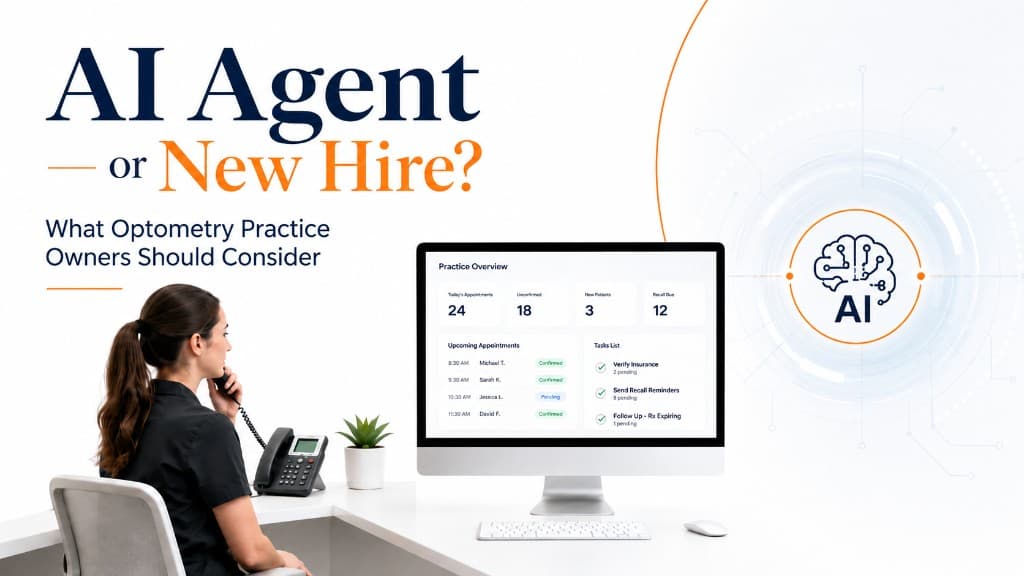
A growing optometry practice can reach an awkward point.
There is enough administrative work to keep the team busy, but not necessarily enough of the right kind of work to justify adding another full-time employee.
Appointment follow-ups need to go out. Routine patient questions need answers. Messages have to be routed. Documents need to be organized. Insurance and scheduling workflows create repetitive administrative tasks throughout the day.
At some point, practice owners may begin asking whether another employee is the answer—or whether artificial intelligence and automation could take some of that work off the team's plate.
That can be a useful question, but the comparison should not be framed as:
"Can AI replace an employee?"
A better question is:
"Which parts of this workload actually require a person?"
For many eye care practices, the best answer may ultimately involve both people and technology.
Start With the Work, Not the Technology
An AI agent is software designed to perform a defined sequence of tasks with some degree of independence.
Unlike a basic chatbot that simply responds to a question, an AI agent may be able to retrieve information, follow predefined workflows, summarize information, trigger actions, route requests or help complete repetitive administrative work.
In an optometry practice, that could potentially include tasks such as:
Answering common non-clinical questions using approved information
Preparing first drafts of routine patient communications
Sorting incoming requests
Routing messages to the appropriate staff member
Helping employees locate information in internal policies
Summarizing routine information for follow-up
Triggering reminders based on predefined rules
Organizing administrative data for staff review
The important distinction is that AI tends to work best when the task is predictable, repetitive and governed by clear rules.
Tasks involving clinical judgment, sensitive patient situations, unusual exceptions or decisions that materially affect patient care still require appropriate human oversight.
That distinction matters more than whether the technology itself sounds impressive.
Look at What Is Actually Consuming Staff Time
Before hiring another person—or purchasing an AI solution—practice leadership should first identify where employee time is going.
For example, is the front desk overwhelmed because the practice genuinely needs another person interacting with patients?
Or are employees spending hours every week repeating administrative tasks that could potentially be streamlined?
Those are two very different problems.
A staffing shortage may require another employee.
A workflow problem may require better technology.
And in many practices, the answer may be improving the workflow first and then evaluating whether additional staffing is still necessary.
This is why technology decisions should begin with observation rather than a product demonstration.
Look at what employees are doing repeatedly.
Where are bottlenecks occurring?
What work is being delayed?
Which tasks require professional judgment, and which ones are simply consuming time because they have always been done manually?
Those questions often reveal more than asking, "What AI tools should we buy?"
Where AI May Help an Optometry Team
The strongest candidates for automation are generally tasks where consistency matters more than human judgment.
For example, an AI-enabled workflow might help organize incoming information before an employee reviews it.
It could prepare a first draft of a routine message rather than requiring someone to start from a blank screen.
It might help categorize requests so they reach the correct department more quickly.
It could also help employees find answers in approved internal procedures without searching through multiple documents.
The potential benefit is not necessarily eliminating a position.
It may be allowing your existing staff to spend more time on the work that actually needs them.
That could include:
Helping patients
Resolving complicated scheduling issues
Working through insurance questions
Managing optical sales
Coordinating with vendors
Supporting providers
Handling unusual situations
Building patient relationships
Those are areas where communication, judgment and experience still matter enormously.
If technology removes some of the repetitive work surrounding those responsibilities, employees can focus more of their attention on the parts of their job that provide greater value to the practice.
Where a Human Still Matters More
There are also many situations where an AI agent should not be treated as a substitute for a person.
Consider an upset patient calling about a billing issue.
That conversation may require empathy, context and the ability to make an appropriate exception.
A complicated insurance problem may require someone who understands the practice's procedures and knows when something does not fit the usual pattern.
A clinical question should be handled by an appropriately qualified professional—not an automated tool attempting to provide a convincing response.
The same principle applies to technology decisions.
AI may help organize information, but it should not independently decide whether your practice should replace its EHR, whether a cybersecurity incident is serious or whether a diagnostic device should be connected to the network.
The more serious the consequences of a mistake, the more important human oversight becomes.
Ask These Questions Before Automating a Task
Before assigning a workflow to AI, practice leadership can use a simple framework.
1. Does the task require judgment, empathy or clinical context?
If the answer is yes, the task probably still belongs primarily with a person.
2. Is the task repetitive and governed by clear rules?
The more predictable the process, the stronger it may be as an automation candidate.
3. What happens if the system gets something wrong?
This is one of the most important questions.
A mistake in an internal document summary is very different from a mistake involving patient information, treatment instructions or a financial transaction.
4. Does a person need to approve the final action?
For many practices, a sensible starting point is:
AI drafts. Staff approves.
That provides efficiency without removing human control.
5. Can the practice measure whether the technology is helping?
Useful measurements might include:
Administrative hours saved
Response times
Number of tasks completed
Error rates
Escalation rates
Staff satisfaction
Patient experience
If the practice cannot define what success looks like, it will be difficult to know whether the technology is actually improving anything.
Before AI Gets Access to Practice Data, Ask More Questions
This is especially important in healthcare.
An AI tool may be useful operationally while still creating security, privacy or compliance concerns if it is deployed without understanding what information it can access.
Before connecting an AI system to practice data, ask:
What information will the tool be able to see?
Could it access protected health information?
Where is the information stored?
Is the vendor using submitted data to train its models?
Who inside the practice can use the system?
What permissions does the application require?
How will activity be monitored?
What happens if the account is compromised?
Can access be removed quickly?
Does the vendor support the practice's HIPAA-related requirements?
These questions should be answered before a new tool becomes part of everyday operations.
AI does not eliminate the need for normal cybersecurity practices.
It adds another system that needs to be evaluated, secured and managed appropriately.
A HIPAA Security Risk Assessment is one way to make those gaps visible before a new tool is connected to patient information.
Your Existing IT Environment Still Matters
Eye care practices already operate complicated technology environments.
A typical practice may rely on:
Diagnostic imaging systems
OCT equipment
Visual field systems
Optical and lab platforms
Workstations
Email
Phone systems
Patient communication platforms
Insurance portals
Adding an AI platform without considering how it interacts with the rest of that environment can create another disconnected system for employees to manage.
That is why AI adoption should be part of a larger technology strategy rather than treated as an isolated software purchase.
The technology may be useful, but it still needs appropriate permissions, cybersecurity controls, vendor management and integration planning.
FAQ: AI Agents in an Eye Care Practice
Can an AI agent replace an employee?
In some situations, automation may reduce enough repetitive work to delay the need for an additional hire.
For most practices, however, the more realistic goal is not replacing employees. It is allowing current employees to spend less time on repetitive administrative work and more time on responsibilities that require human judgment and interaction.
Does every optometry practice need an AI agent?
No.
If the workload is inconsistent, highly specialized or heavily dependent on judgment, adding AI may create more complexity than it removes.
Technology should solve a specific operational problem.
What should happen before an AI agent is deployed?
The practice should identify the exact workflow, determine what information the tool can access, define where human review is required, evaluate security and privacy considerations, and establish how success will be measured.
Should AI be allowed to work completely independently?
That depends on the task.
For higher-risk workflows, human review should remain part of the process. Many practices may be better served by starting with AI-assisted workflows rather than fully autonomous ones.
Make the Decision Based on the Practice, Not the Hype
For optometry practice owners, the AI-versus-hire decision is ultimately a workflow question—not a technology contest.
If the real problem is a shortage of human judgment, communication or patient-facing support, the practice may need another person.
If the problem is that talented employees are spending too much time on repetitive administrative tasks, automation may be worth evaluating.
And sometimes the right answer is both.
The goal should not be to automate as much as possible.
The goal should be to create a practice where employees can spend more of their time doing the work that truly needs people.
IT4Eyes helps eye care practices evaluate technology in the context of the entire practice environment. That includes understanding how new tools interact with the EHR, workstations, cybersecurity controls, vendors, patient information and existing workflows.
Before adding another piece of technology, it is worth making sure it will actually make the practice simpler—not give the team one more system to manage.